

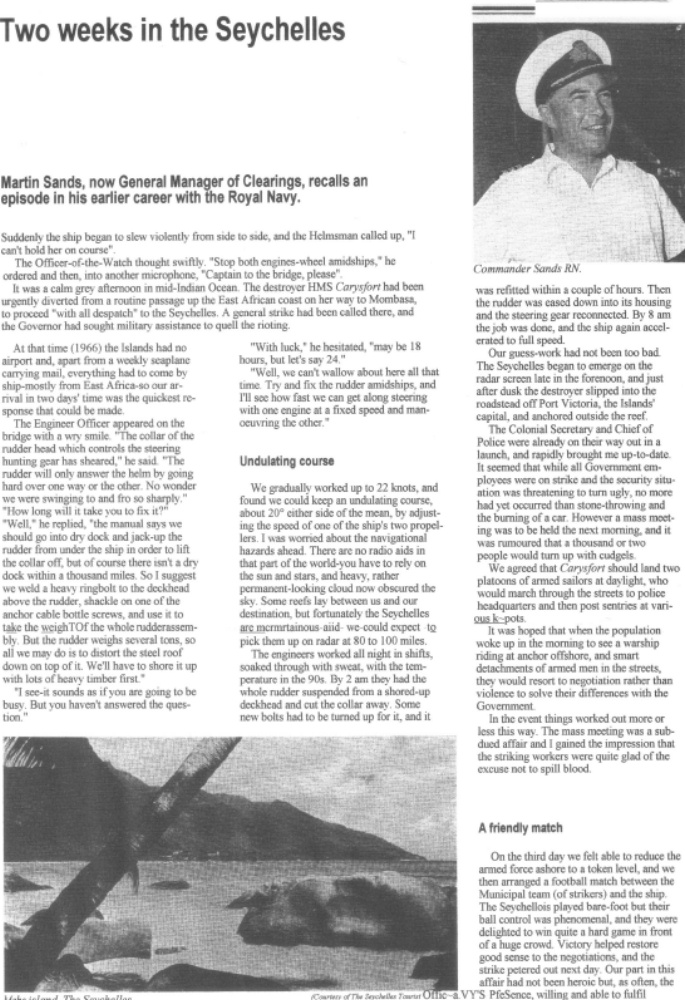
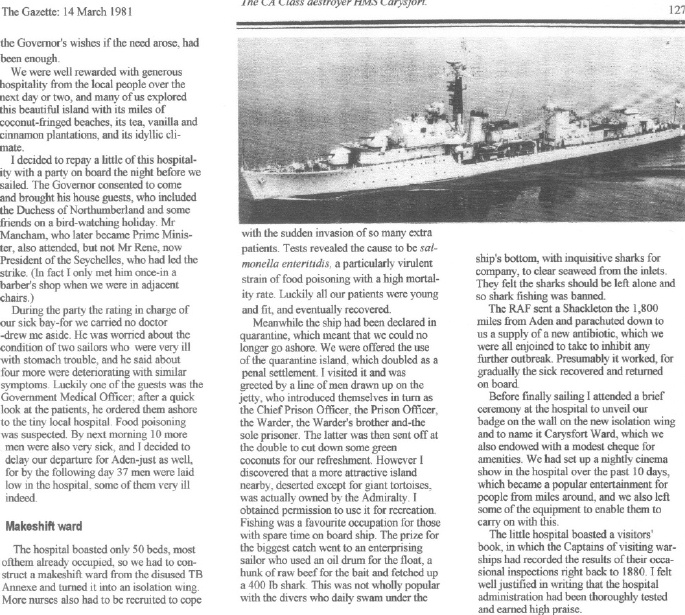
The following article is displayed as received from ex AB Joe (Basher) Bates in July 2011 and the author Commander Martin Sands who wrote it 30 years earlier in 1981 has kindly given his permission for it to be included in the website.
I served
as a Surgeon Lieutenant in Carysfort during the epidemic in the
Seychelles. I flew in from Gurkha and immediately got to work sorting out
the infection that had affected about 35 sailors. When all were better we
went to Aden for clearance of secondary carriers and then when all were
identified and treated we sailed for Mombasa encountering heavy weather on
the way. One sailor developed an acute abdomen which was operated on in
Mombasa with success.
Off to the Beira patrol where sadly I left
to transfer to Leopard. I will never forget the send off under an arch of
SH*T sample pots and the present of a string of onions!
I
served in many ships and sorted out a few problems but I will always have
a special place in my heart for Carysfort, its great ships company and
Commander Martin Sands who was a great leader.
Laurence
Measey ( sometimes known as 'Harry'.) - 2 August 2011
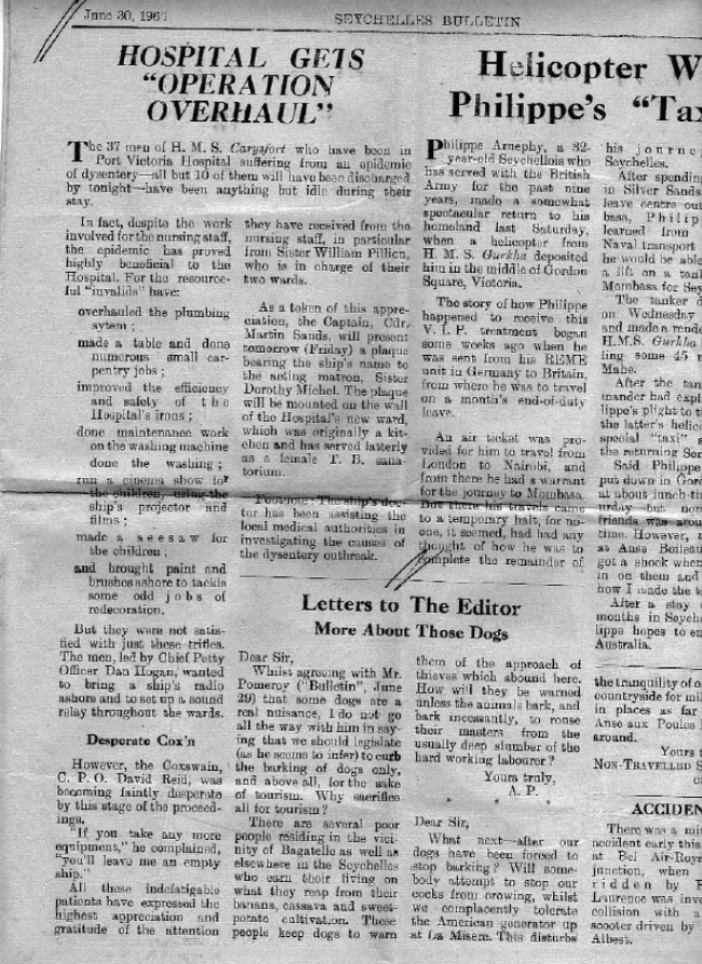
Copy of the signal and a local newspaper clipping reporting the enteritis epidemic in June 1966 provided by Lieutenant P C D Norman RN who was Supply Officer in HMS Carysfort at that time. (Many thanks for this.)
- - - - - - - - - -
- - - - - - - - - - - - - - - - - - - - - - - - - - - - - - - - - - - - -
- - - - - - - - - - - - - - -
ROUTINE 260526Z
FROM
CARYSFORT
TO
M.O.D. (NAVY)
-
- - - - - - - - - - - - - - - - - - - - - - - - - - - - - - - - - - - - -
- - - - - - - - - - - - - - - - - - - - - - - - -
UNCLASSIFIED.
RTT FOR DPR.
OF 35 PERSONNEL FROM CARYSFORT CONFINED ISOLATION WARDS IN VICTORIA
GOVERNMENT HOSPITAL SEYCHELLES WITH ACUTE ENTERITIS INFECTION WHICH HAS
QUARANTINED THE SHIP ABOUT HALF ARE ALLOWED UP AND OCCUPIED IN
IMPROVEMENTS TO HOSPITAL.
PATIENTS HAVE RADIO LINK WITH SHIP USED MAINLY FOR ARRANGING DAILY
SUPPLIES OF SHIPS FOOD TO SUIT MATRONS DIET SHEET.
LATEST STORES DEMAND FROM PATIENTS INCLUDED ONE TOOTHBRUSH, ONE
WATCH LEFT IN OVERALLS, 5 GALLONS OF PAINT, WHITE SPIRIT, 50 YARDS
ELECTRIC CABLE, AVOMETER, SANDPAPER, SCREWS AND TIMBER.
INTEREST
SPREADING TO HOSPITAL GARDEN AND REPAIR OF EQUIPMENT FROM TB
SANITORIUM NEARBY.
NUMBER OF FRESH CASES INDICATED EPIDEMIC SLOWLY DIMINISHING.
ONBOARD SHIP ANCHORED CLOSE BUT ISOLATED FROM SHORES:
MANY PASTIMES ORGANISED INCLUDING FISHING COMPETITION. BIGGEST SO FAR 7 LBS BUT
MONSTERS ESCAPE DAILY.
DESPITE EPIDEMIC SHIP REMAINS READY TO LAND ARMED PLATOON IF
SECURITY SITUATION IN SEYCHELLES DETERIORATED.
PRECAUTIONS ONBOARD INCLUDE STRINGENT HYGIENE MEASURES TO PREVENT
CROSS- INFECTION AMONGST THE 160 PERSONNEL REMAINING WELL.
50 DISAPPOINTED RATINGS DUE TO FLY HOME FOR LEAVE ON 28 JUNE AFTER 2 ½ YEARS ONBOARD MUST WAIT UNTIL INFECTION FINALLY ELIMINATED.
CAUSE
UNDER URGENT INVESTIGATION AND SOME POINTERS EMERGING.
DTG
…260526Z/JUNE 66
 To see details of the Commander in Chief Middle East's Commendation
awarded to the Coxswain A/CPO Dave (Blood) Reid.
To see details of the Commander in Chief Middle East's Commendation
awarded to the Coxswain A/CPO Dave (Blood) Reid.
The following was taken from a magazine article:
The
year 1966 saw, for the first time in the history of Seychelles, a May
Day procession. The protests against poor working and living conditions
were gaining momentum. At the beginning of the year the workers who were
employed by the W&C French construction company and who were members
of the Transport and General Workers Union went on an unofficial strike.
The Union officials had to ask them to call off the strike though the
officials wrote to government to ask for an increase in wages of
labourers working for government. However, in June the colony was on the
verge of a national strike. Thousands of workers belonging to the
Transport and General Workers Union and the newly-formed Building and
Construction Workers Union joined the strike which had been sparked by a
government’s offer of a wage increase of only 11%. The unions had been
asking for a 40% increase as the cost of living was said to have risen
by almost 100% over the recent years. As the strike extended to the
other main islands, Praslin and La Digue, the country was virtually
paralysed with only the essential services running. It was then that the
colonial authorities called for the British troops to intervene and a
contingent armed with rifles and bayonets were landed from the warship,
HMS Carysfort, which arrived from Mombasa. Police had already been given
orders to arrest people assembling in any public places.
An agreement was finally reached as the
workers returned to work and none were dismissed. They were awarded a
28% pay rise though there was much delay in awarding it. Meanwhile, at
the United Nations there was a strong protest against the British
‘gun-boat policy’.